Portable Labs

Portable
Labs

A one-person solution lab run by Alexander Fetisov. I build data systems, desktop tools and AI agents, mostly for problems I’ve met in fourteen years of data and analytics work.

Live
Daxis, the desktop editor for Fabric semantic models
Live
findmeaschool.au, 9,529 Australian schools on one map
On the bench
jev-guard, a circuit breaker for looping coding agents

By day I lead BI, data and AI solutions for Customer Markets at AGL Energy. Nights and weekends, the lab ships products and takes on client builds where one senior builder beats a whole agency.

Start a project

Projects

Products out of the lab, plus private solutions built for clients and teams.

  • Live · v0.1.0

    Daxis

    The desktop editor for Microsoft Fabric semantic models, on Windows and Linux. Trace sources to reports, see refresh health, memory and what nobody uses, and edit DAX and Power Query with every change reviewed. Free for individuals and small businesses. The lab’s flagship product.

    Watch the demo and details
  • Live · v2.1.0

    PocketWUI

    Your Cardputer’s SD card, in any browser. Browse, preview, upload and download files on an M5Stack Cardputer from a phone or laptop, over Wi‑Fi or one USB cable. No app, no cloud. Open source.

    Watch the demo and details
  • Live · open source

    murmur

    A Herdr plugin that shows your running AI coding agents as a live org chart: who spawned whom, what each was told, cost by model, context load, and which ones are waiting on you. Approve or interrupt them without leaving the tab. Local-only, zero dependencies.

    Get murmur on GitHub
  • Every school and daycare in Australia on one searchable map, with sector, gender, fees and websites stitched together from state directories and open data.

    Open the app
  • Live

    BalanceUs

    Expense sharing for couples and small groups. Add, split and settle in three taps.

  • v0.1

    jev-guard

    A Claude Code plugin that trips when agents loop or drift, plus a skill that lints and evolves other skills against evals.

  • v0.2

    cardputer-music

    Firmware that turns a pocket ESP32 computer into an MP3 player and Spotify remote, with a small Docker hub for streaming.

Private projects and solutions

Built for clients and internal teams. Details are shared on request.

  • Private

    Construction Program Analyser

    Reads construction programmes and surfaces schedule risk and logic issues early, so planners and project leaders act before delays land.

  • Private

    Project Controls Solutions

    Cost, schedule and progress reporting for major projects, brought into one trusted view for project controls teams and leadership.

  • Private

    Evolving agentic pipelines

    An internal platform of agent pipelines and workflows that are measured against evals and improve over time, not left to drift.

← All projects

Live · v0.1.0 · Windows and Linux

Daxis

The desktop editor for Microsoft Fabric semantic models. See how models, reports and refreshes fit together, where the memory goes and what nobody uses, and edit DAX and Power Query with every change reviewed before it’s saved.

80-second walkthrough. All data shown is fictional.

Across the workspace

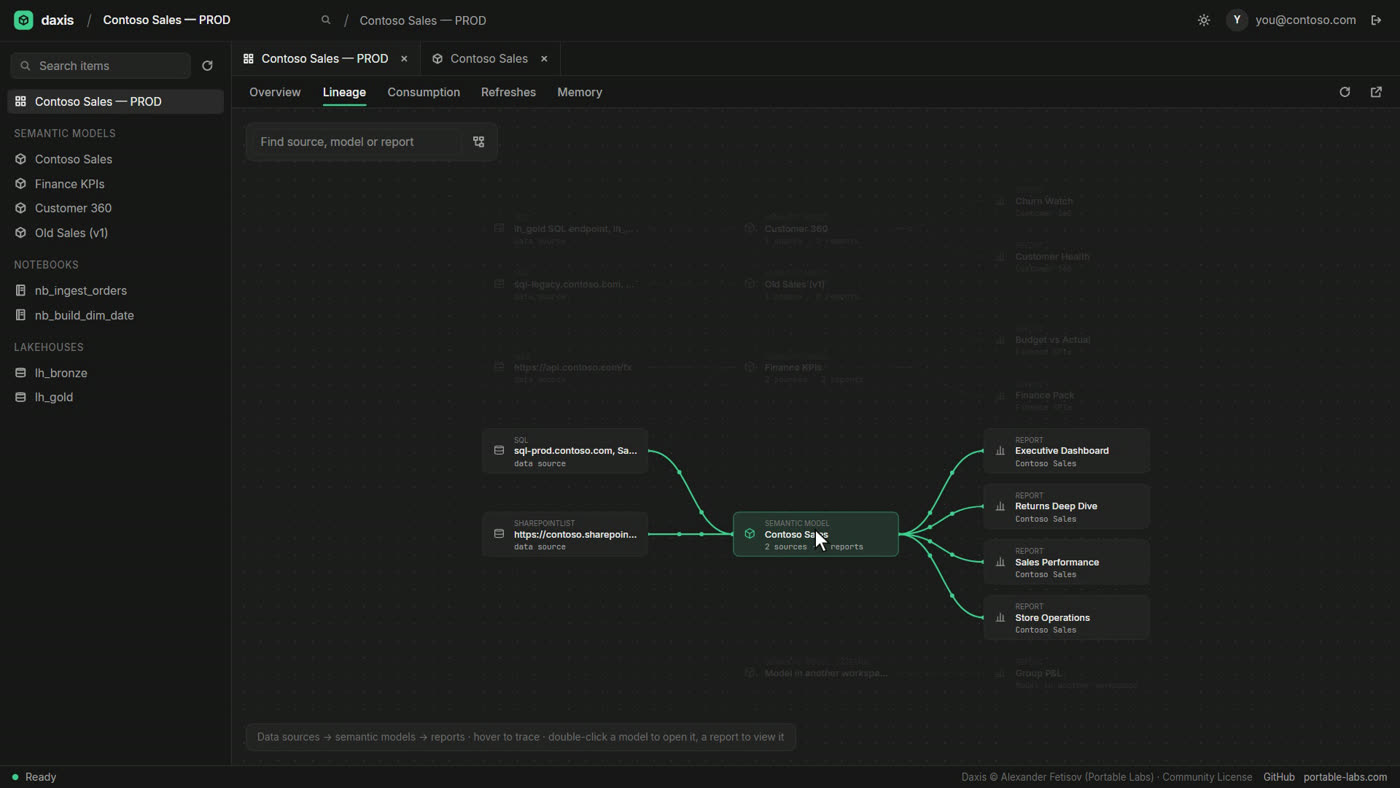
  • Lineage from data sources to semantic models to reports. Hover any card to trace its path.
  • Consumption: how much of each model your reports actually use.
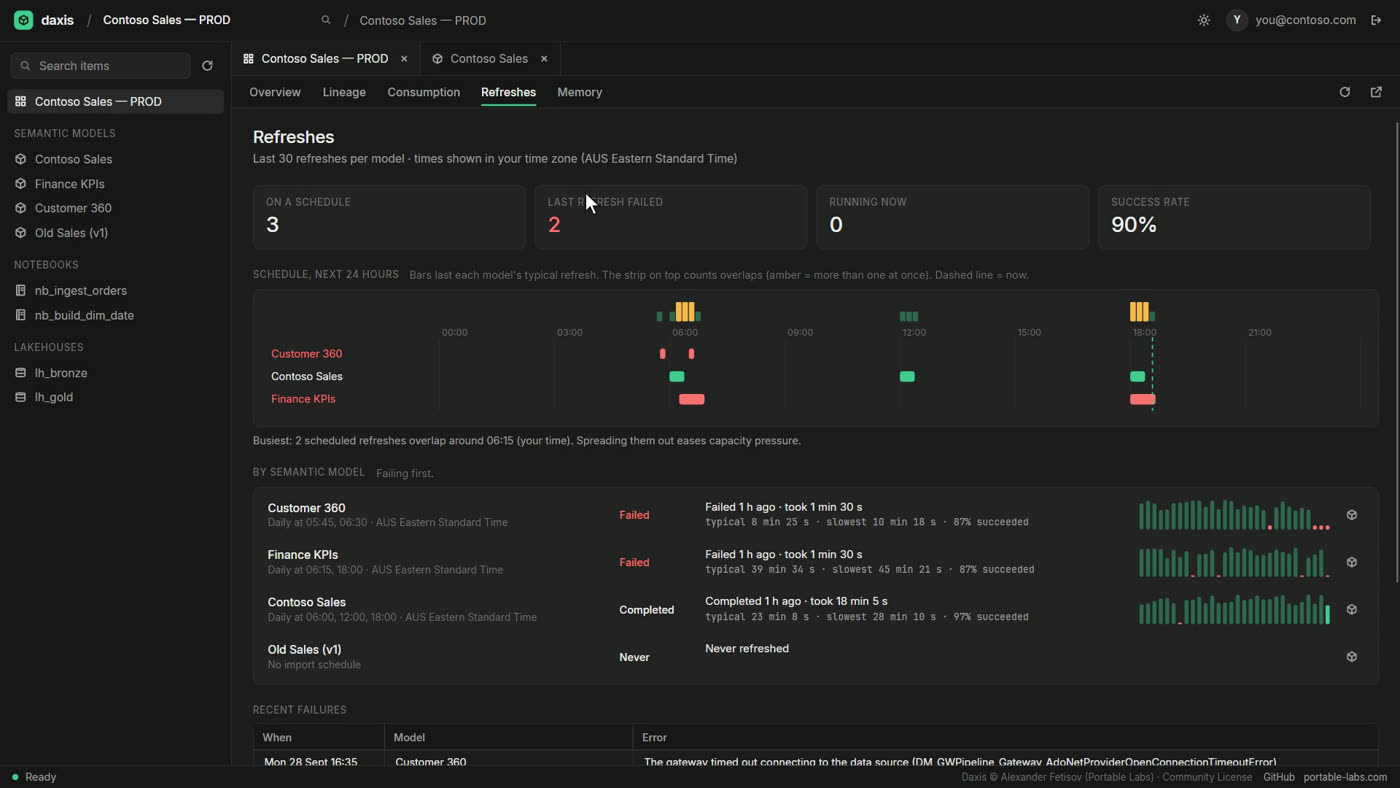
  • Refreshes: a 24-hour schedule timeline that shows overlaps, success rates, and failures explained in plain English.
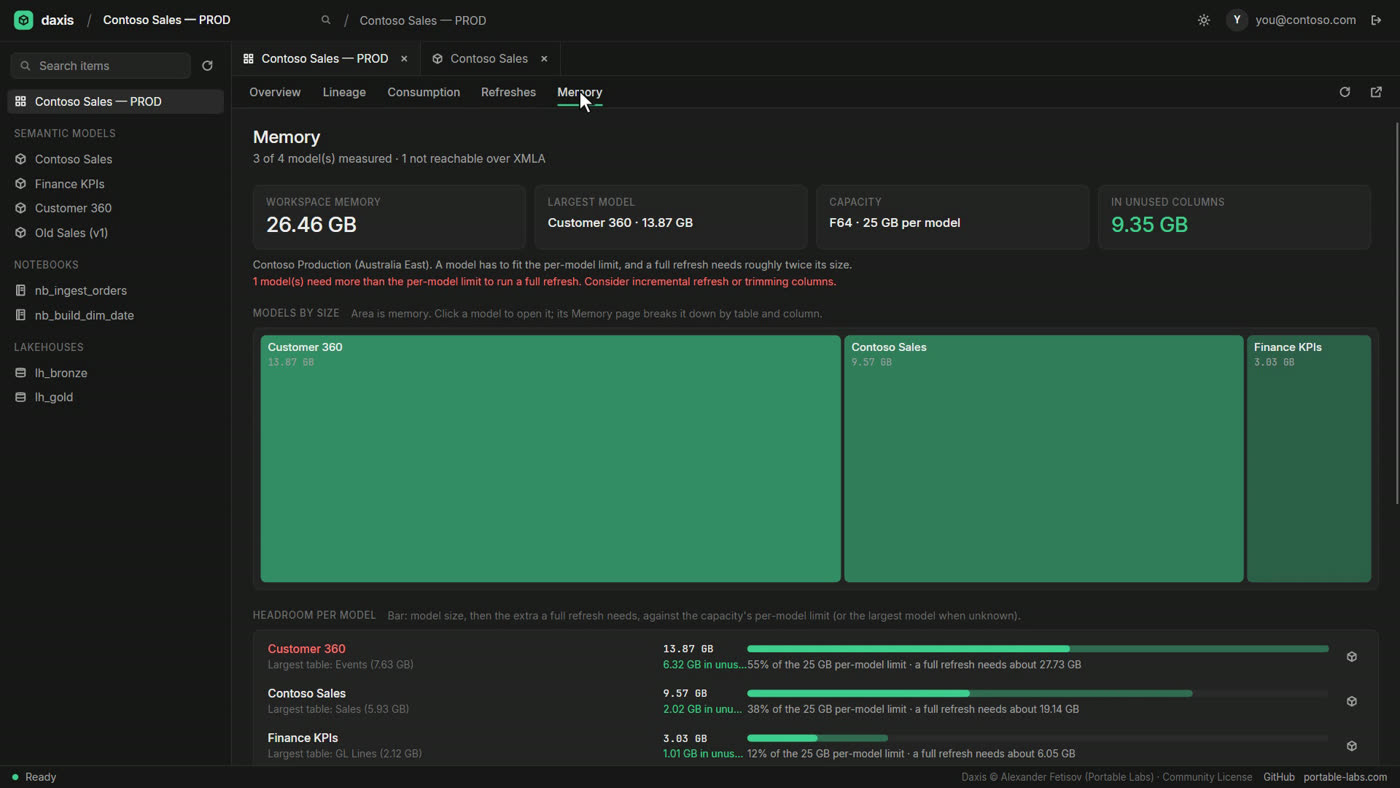
  • Memory per model, against your capacity’s per-model limit and the headroom a full refresh needs.

Inside a model

  • Diagram of tables and relationships, and pipeline lineage from source query to report.
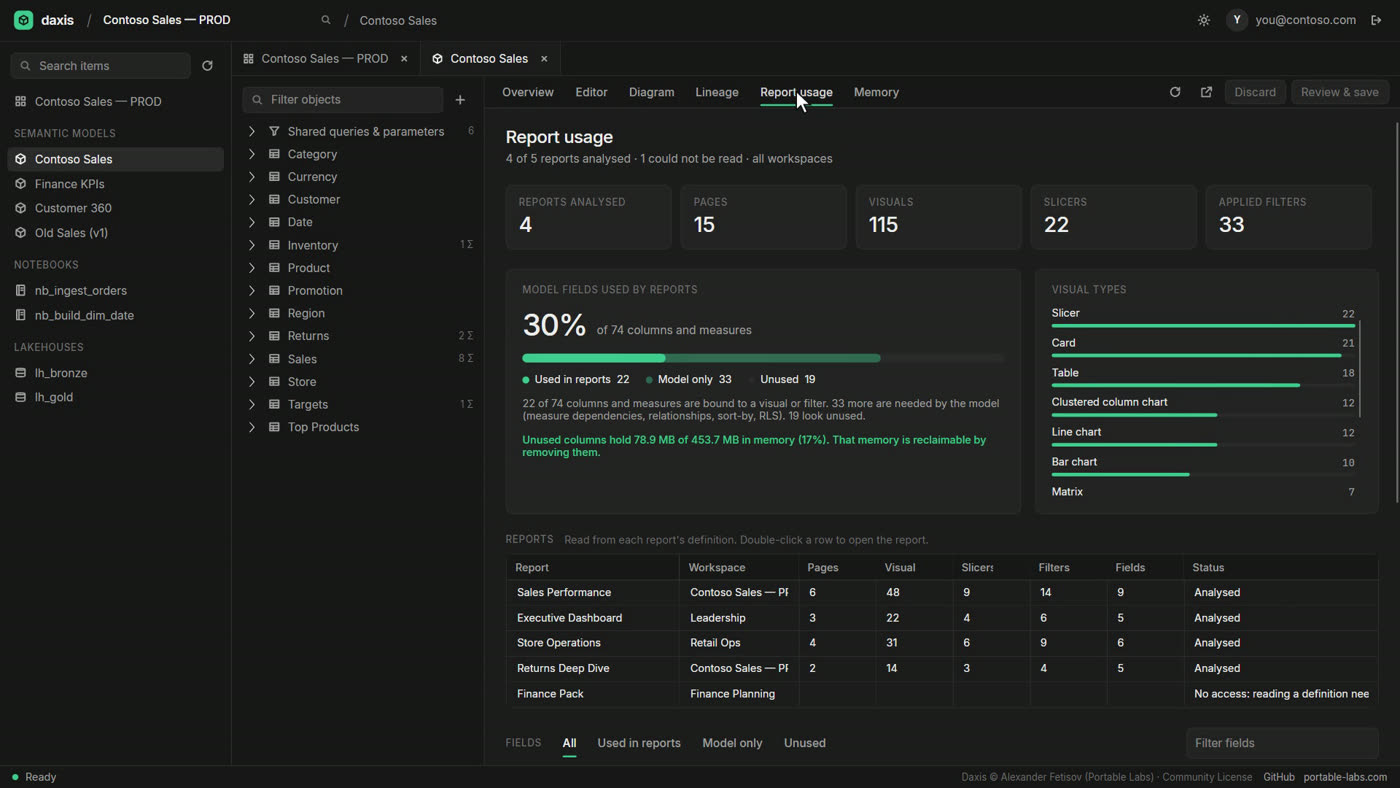
  • Report usage: visuals, slicers and filters per report, and every column marked used, model-only or unused.
  • Memory by table and column, and how many MB sit in unused columns.
  • Edit DAX and Power Query with IntelliSense and formatters. Nothing is written until you review the before and after.

Safe by design

  • No Daxis server and no telemetry. It only talks to Microsoft.
  • Tokens stay on your machine, encrypted on Windows.
  • Every change to Fabric needs your confirmation.
  • Source-available: read the code, build it yourself.
Workspace lineage traced from one model
Workspace lineage
Refresh schedule timeline and failures
Refresh health
Memory per model against the capacity limit
Memory against the capacity limit
Report usage and unused columns
Report usage

Get it

Download the Windows or Linux build from Releases, or run it from source with the .NET 8 SDK:

git clone https://github.com/AFetisa/daxis.git
cd daxis
./run.sh      # or .\run.ps1 on Windows

What you need

A work or school account on Microsoft Fabric. Semantic-model features need a Fabric, Premium or PPU capacity with the XMLA endpoint turned on.

Licence

Free for individuals, non-profits, education and small businesses. Other companies can use it with acknowledgement; large consultancies need written consent. Daxis Community License.

← All projects

Live · v2.1.0 · M5Stack Cardputer and Cardputer ADV

PocketWUI

Your Cardputer’s SD card, in any browser. Browse, preview, upload and download files from a phone or laptop, over Wi‑Fi or one USB cable. No app, no cloud, no internet needed.

68-second walkthrough, no sound.

Your files, anywhere

  • Upload files and whole folders by drag and drop. Transfers resume after a Wi‑Fi hiccup, at any size.
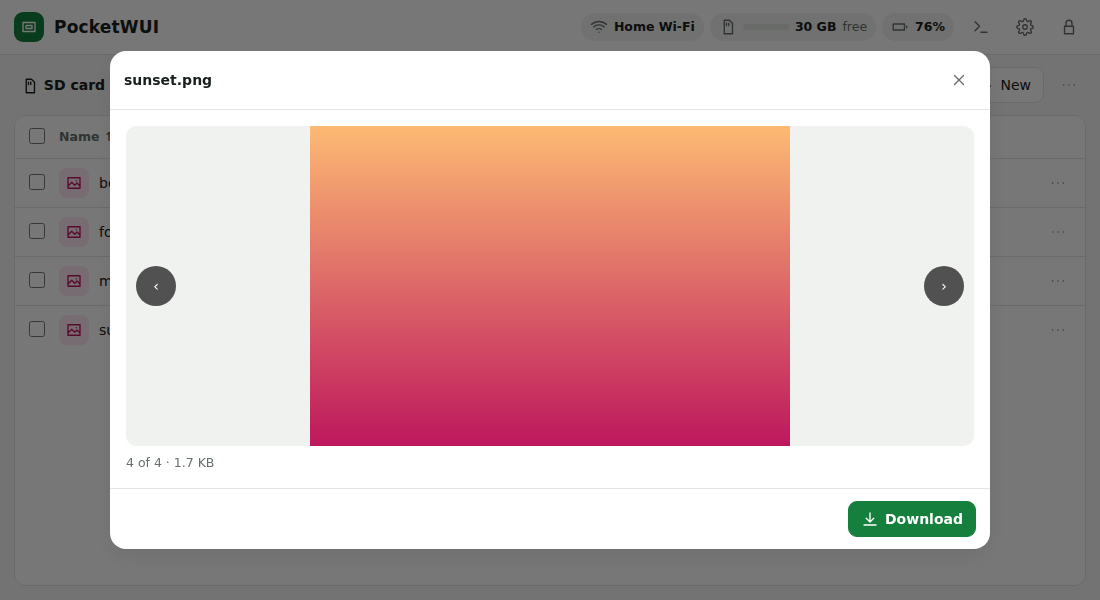
  • Preview photos, video, music, PDF and text, and edit notes in place.
  • Search the whole card, download any selection as one ZIP, and recover from Trash.

Connect your way

  • Wi‑Fi: join your home network, or the Cardputer’s own hotspot with a QR code.
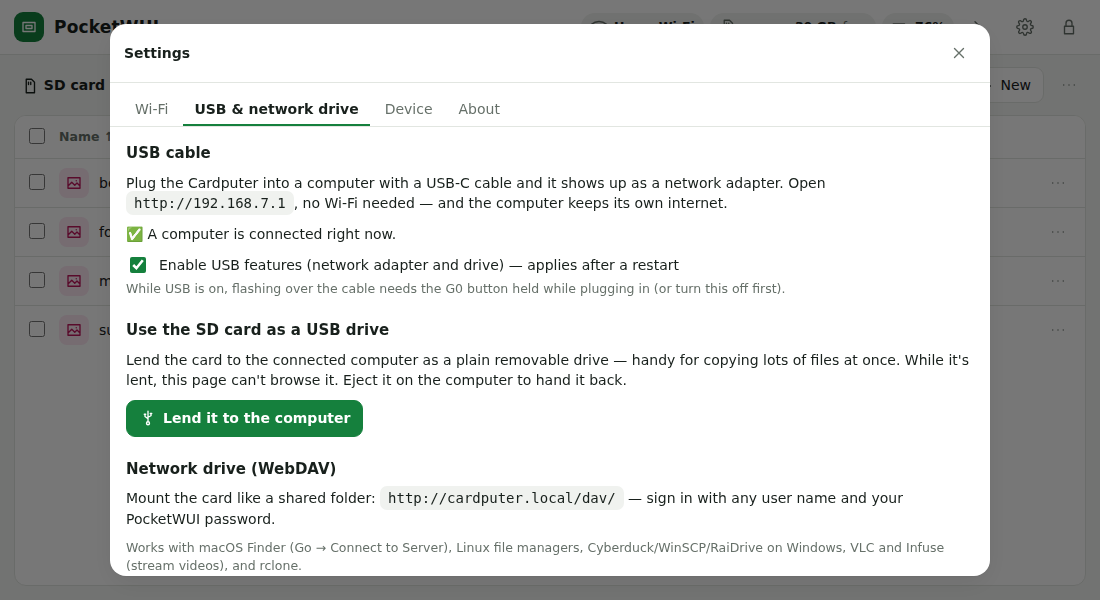
  • USB cable: a network adapter at 192.168.7.1, or lend the card to your computer as a USB drive.
  • Network drive: WebDAV for Finder, VLC, Infuse and rclone.

Private by design

  • Everything stays on the card. No account, no cloud, no internet needed.
  • No default password: a random one is made on first boot and shown only on the device.
  • Sign-in QR codes work once and expire after two minutes.
  • Open source under the MIT licence.
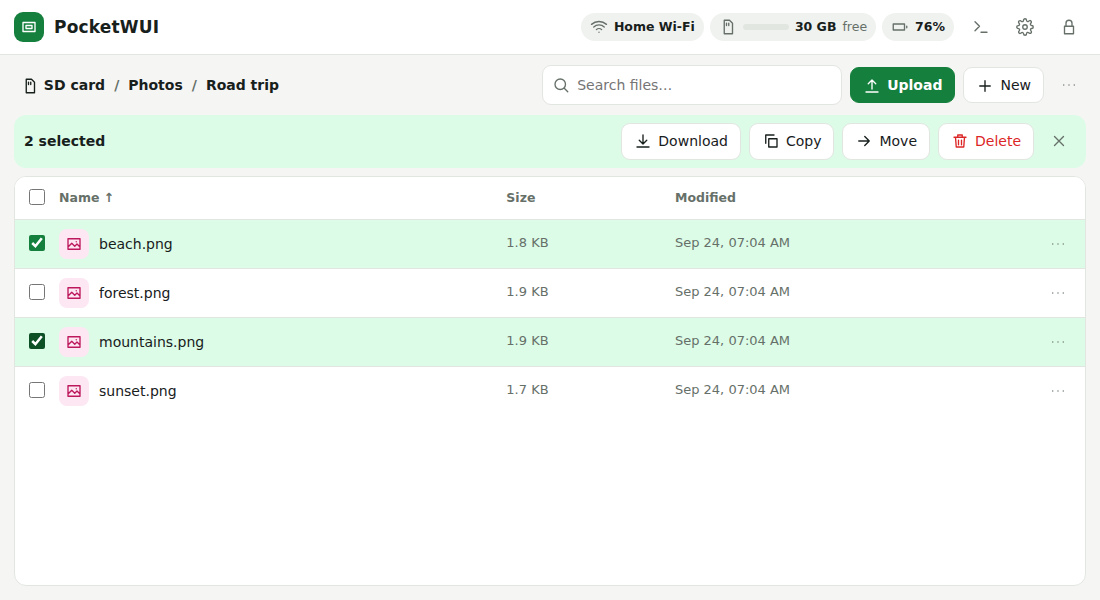
PocketWUI file list in a desktop browser
Files in a desktop browser
Photo preview in PocketWUI
Previews
USB and network drive settings

Get it

Download PocketWUI.bin from the latest release and copy it to the SD card. On the Cardputer, open M5Launcher → SD → PocketWUI.bin → Install.

First run

The screen shows a Wi‑Fi name and a password. Press the side button for a QR code to join, and again to sign in. Add your home Wi‑Fi in Settings, then use http://cardputer.local.

Without M5Launcher

Flash PocketWUI-full-flash.bin at 0x0 with esptool-js in the browser.

Cases

Two engagements, told plainly: what was broken, what got built, and what changed.

All construction reporting, centralised

Fifty projects, one version of the truth. Nobody misses their private copy of the report. Well, almost nobody.

Problem

Across more than fifty construction projects, every team kept its own copies of reports and models. Each copy drifted a little. Once there were twelve “certified” versions of the same number, certified stopped meaning anything.

Approach

One clear pathway with named ownership. Certified datasets and reports are the source of truth, and they stay true. Anyone can suggest a change, and metric owners and subject-matter experts review every one before it lands. Teams were onboarded onto certified data with easy, safe ways to experiment, so good ideas come in through proper engineering instead of leaking out into silos.

Result

A reporting estate that evolves instead of fragmenting. New ideas get pulled in, reviewed and shipped for everyone, rather than living in someone’s downloads folder.

Projects onboarded
50+
Certified versions of each metric
1
Changes that skip review
0

An AI platform for Fabric reporting optimisation

One place to rule them all. Built with better governance than Sauron managed.

Problem

Reporting estates grow faster than anyone can review them. Weak models, tangled architectures and policy drift spread across tools that don’t talk to each other. Most AI answers to this just add one more tool to the pile.

Approach

A system-agnostic platform that connects to GitHub repositories, any other source code, and the systems around them. An orchestrated team of AI agents does the heavy lifting: it rebuilds poor solutions and architectures, follows organisation policy, builds and tests in safe environments, and gathers business context and feedback from the people who use it. Adding a new source or feature is part of the design, so the platform keeps growing with no fixed ceiling. The rule throughout: add real value, never AI for the sake of AI.

Result

A meta-application that sits on top of every other tool in the organisation. What it learns feeds the enterprise “brain” and surfaces wherever people already ask questions, from enterprise chatbots to the tools they use every day.

Systems it’s locked to
None
Changes built and tested safely first
All
Places to look
1

CV

Data and AI leader who still ships code. I set strategy at executive level and build the systems myself, so the two never drift apart.

Savings and risk avoided
$100M+
Years leading data and AI
10+
Successful start-ups
2
Industries served
8
  1. 2025 to now

    Solutions Lead, BI, Data Analytics and Reporting

    AGL Energy

    Own the Customer Markets data and AI strategy, and AGL’s data governance and AI solutions strategy. Lead 25 BI developers, data engineers and automation developers, and am building the company’s centre of excellence for agentic AI.

  2. 2022 to now

    Co-founder, CPTO to 2025, now Advisor

    Lumiate

    Set product and technology vision for an AI product that removes inefficiency in construction. Directed AI and ML development for accuracy, scale and compliance, led product and engineering teams, and pitched to investors.

  3. 2018 to now

    Independent consultant, now Portable Labs

    Australia and international

    Data strategy, BI, UX research, process automation and AI delivery for construction, manufacturing, software, government, cyber security, retail and sport.

  4. 2016 to 2025

    Business Intelligence Manager

    John Holland Group

    Product owner for the organisation’s Power BI suite. Led enterprise reporting strategy worth $50M+ a year in savings and operational gains, the migration to Databricks, and a national data and analytics team. Earlier roles in enterprise reporting, project reporting and process analysis.

  5. 2012 to 2016

    Consulting and quality roles

    Deloitte, National Bank Trust, CEVA Logistics

    Consulting at Deloitte, IT quality assurance in banking, and quality in logistics.

Education

  • Master of International Business, University of Sydney
  • Master of International Technology and Innovation Management
  • Bachelor of Management
  • UX Design, Academy Xi

Leadership

  • Data, AI and governance strategy
  • Building and mentoring teams
  • Product management
  • Investor relations
  • Public speaking and workshops

Off the clock

Brazilian jiu-jitsu, rock climbing, kitesurfing, photography, painting and jewellery making.

Contact

Tell me what you’re trying to fix. I read every message myself and reply within a business day.

Prefer email?

[email protected]

Elsewhere

Based in Melbourne. Taking on a small number of projects for 2027.

Good fits: semantic models that have grown out of control, reporting that needs an engineer’s eye, internal tools, and agent workflows that should run without babysitting.